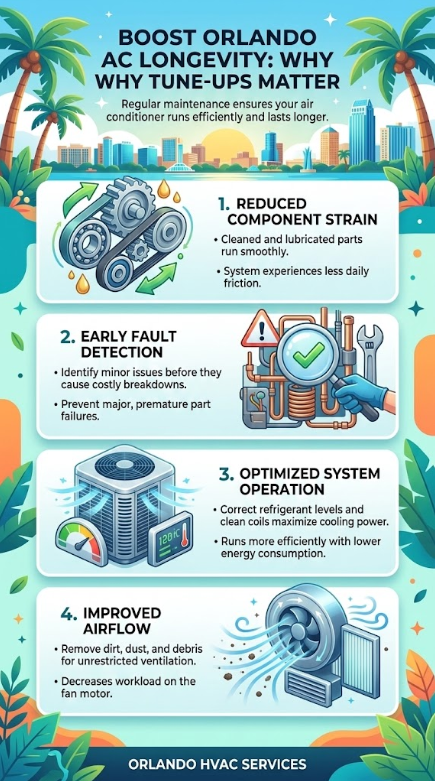
In Orlando, your AC doesn't get a break—and neither does the wear accumulating inside it.
We've serviced thousands of Central Florida systems, and the pattern is consistent: tuned-up ACs routinely reach 15 to 20 years. Neglected ones often don't make it to 10. That gap isn't bad luck—it's the direct result of compressor strain, refrigerant imbalance, and coil buildup that a single annual tune-up catches and corrects before permanent damage sets in.
This page shows you exactly what changes after a professional tune-up, why Orlando's humidity accelerates system wear faster than most climates, and how maintenance today keeps a costly replacement off your calendar for years to come.
TL;DR Quick Answers
What Is an HVAC Tune-Up in Orlando?
An HVAC tune-up in Orlando is a professional maintenance service that inspects, cleans, and corrects the mechanical conditions that cause AC systems to fail prematurely in Central Florida's demanding climate.
What it includes:
Coil cleaning
Refrigerant level adjustment
Capacitor and contactor inspection
Condensate drain clearing
Electrical connection tightening
Airflow measurement and thermostat calibration
Why it matters in Orlando specifically:
Central Florida systems run 10 to 12 months per year
High humidity accelerates coil corrosion and drain blockages faster than most climates
Neglected systems in Orlando routinely fail years before their expected lifespan
What consistent tune-ups produce:
Lower monthly energy bills
Fewer emergency repairs
AC systems that reach 15 to 20 years instead of 8 to 10
A professional HVAC tune-up in Orlando isn't optional maintenance — it's the single most cost-effective action a homeowner can take to protect their cooling system in one of the most demanding climates in the country.
Top Takeaways
Orlando's climate is uniquely hard on AC systems. Near year-round runtime, high humidity, and heat cycles create wear conditions that most climates never produce.
The difference between a 10-year system and a 20-year system is almost always maintenance. Longevity isn't luck — it's a maintenance record.
Dirt and neglect are the leading causes of HVAC failure — and both are preventable. Coil buildup, refrigerant drift, and capacitor degradation follow a predictable pattern that a tune-up catches before permanent damage sets in.
The math works decisively in favor of maintenance. Heating and cooling account for up to 43% of the average home energy bill — and regular maintenance returns 10% or more of that back.
Deferred maintenance is the most expensive HVAC decision most Orlando homeowners make. Skipped tune-ups move the replacement date forward — often by years — and most homeowners don't see it coming until it's too late.
Why Orlando's Climate Is Hard on AC Systems
Central Florida doesn't have an off-season. Your air conditioner runs 10 to 12 months out of the year, accumulating wear that systems in cooler climates simply never experience. High humidity accelerates coil corrosion. Heat cycles stress electrical components. Dust, pollen, and mold spores load up filters and restrict airflow faster than the national average. By the time most Orlando homeowners notice a performance drop, the damage causing it has been building for months.
What a Tune-Up Actually Does to Your System
A professional HVAC tune-up isn't a simple inspection—it's a systematic reset of the conditions that cause premature failure. We clean evaporator and condenser coils that have been quietly losing efficiency, recalibrate refrigerant levels that have drifted out of spec, tighten electrical connections that vibration has slowly loosened, and lubricate moving parts that friction has been wearing down. Each correction reduces the mechanical stress your system carries into the next cooling season.
The Components Most Affected by Skipped Maintenance
The compressor takes the hardest hit when tune-ups are skipped. It's the most expensive component in your system and the most sensitive to refrigerant imbalance and restricted airflow—two problems that routine maintenance directly addresses. Capacitors and contactors are next. We replace these inexpensive parts during tune-ups specifically because failure under peak summer load is what triggers emergency calls in July and August. Catching them early is the difference between a planned maintenance visit and an unplanned replacement.
How Maintenance Math Works in Your Favor
A system that reaches 18 years instead of 9 effectively cuts your lifetime replacement cost in half. In the Orlando market, that's the difference between replacing your AC once over two decades versus twice. Annual tune-up costs are modest against that math. More importantly, a well-maintained system runs more efficiently throughout its life—meaning lower monthly energy bills compound the savings well beyond the replacement cost alone.
What Orlando Homeowners Tell Us After Their First Tune-Up
The most common thing we hear after a first tune-up is surprise—surprise at how much the system was struggling before, and how noticeably it performs afterward. Cooler air, quieter operation, and lower utility bills are the immediate signs. The longer-term benefit is the years added back to a system that was quietly working harder than it needed to.
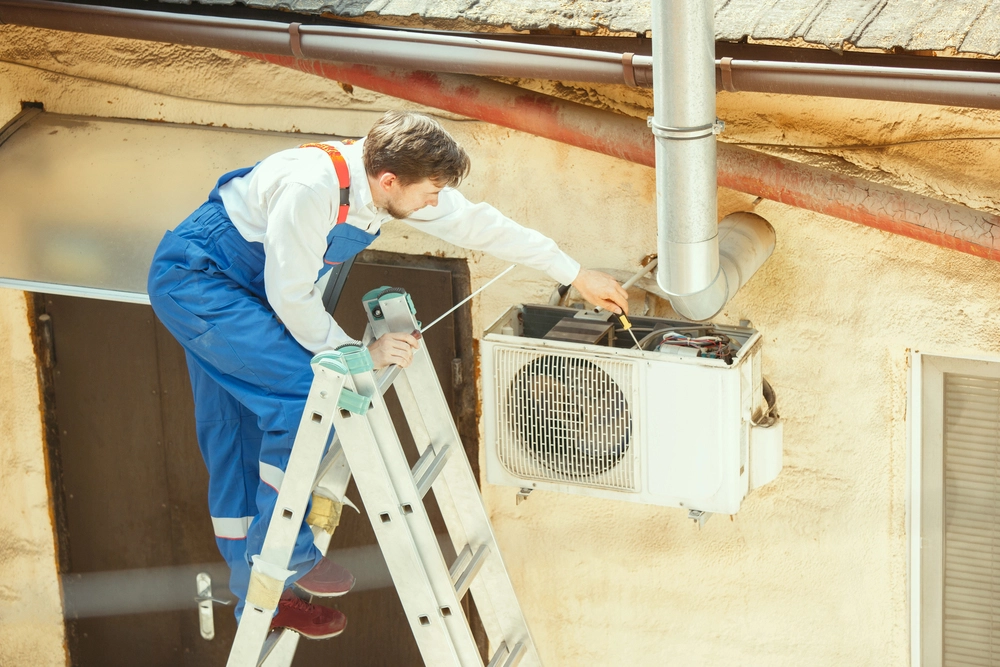
"After servicing thousands of Central Florida systems, the ones that last 18 to 20 years almost always share one thing in common—an owner who scheduled maintenance before there was a problem, not after."
What Every Orlando Homeowner Should Know Before Scheduling an HVAC Tune-Up
We live and work in the same neighborhoods you do — and when neighbors ask us where to start their research, these are the seven resources we point them to first. Every source below comes from a federal agency or official state authority, because we believe you deserve the same trustworthy information we rely on when we're servicing systems right here in Central Florida.
1. What a Professional AC Tune-Up Should Actually Include
Source: U.S. Department of Energy — Air Conditioner Maintenance
URL: https://www.energy.gov/energysaver/air-conditioner-maintenance
When a neighbor asks us what should actually happen during a tune-up, this is the first resource we share. The DOE's official homeowner guide covers every task a qualified technician should perform — so you know exactly what you're paying for and exactly what to ask if something gets skipped.
2. The Maintenance Checklist Your HVAC Contractor Should Be Following
Source: ENERGY STAR — How to Keep Your HVAC System Working Efficiently
URL: https://www.energystar.gov/products/ask-the-experts/how-keep-your-hvac-system-working-efficiently
We follow this checklist ourselves — and we think every Orlando homeowner should know it too. The EPA's official ENERGY STAR maintenance standards tell you precisely what a professional visit should cover, so you're never left guessing whether the job was done right.
3. How an HVAC Tune-Up Qualifies You for Rebates and Tax Credits
Source: ENERGY STAR — Clean Heating and Cooling
URL: https://www.energystar.gov/products/energy_star_home_upgrade/clean_heating_cooling
One of the things we genuinely enjoy telling our customers is that maintaining your system can actually put money back in your pocket. This ENERGY STAR resource outlines the federal rebates and tax credits available to Florida homeowners — savings most people don't know they qualify for until it's too late to claim them.
4. Why Your HVAC System Directly Affects the Air Your Family Breathes
Source: U.S. EPA — Improving Indoor Air Quality
URL: https://www.epa.gov/indoor-air-quality-iaq/improving-indoor-air-quality
We see this firsthand every week in Orlando homes — a neglected HVAC system doesn't just lose efficiency, it circulates the problem. The EPA's indoor air quality guide explains exactly how your system affects the air your family breathes, and why Central Florida's humidity makes maintenance more than just a comfort issue.
5. How to Verify Your HVAC Technician Is Properly Certified
Source: U.S. EPA — Homeowners and Consumers: Frequently Asked Questions
URL: https://www.epa.gov/ods-phaseout/homeowners-and-consumers-frequently-asked-questions
As your neighbors, we'll be straightforward with you: not every technician who shows up at your door is properly certified to handle refrigerants. This EPA consumer guide explains Section 608 certification requirements so you know exactly what credentials to verify before anyone touches your system.
6. The Florida State Standards Governing Your HVAC System's Performance
Source: Florida Building Code — Energy Conservation
Florida has its own standards for how your HVAC system should be installed, sealed, and maintained — and every contractor working in Orlando is required to meet them. We think homeowners deserve to know what those standards are, so we're pointing you directly to the source.
7. The Science Behind Indoor Air Quality and Your HVAC System
Source: U.S. EPA — Indoor Air Quality (IAQ)
URL: https://www.epa.gov/indoor-air-quality-iaq
Living in Central Florida means dealing with humidity, pollen, and air quality challenges that most of the country simply doesn't face at the same level. The EPA's IAQ resource hub is where we send neighbors who want to understand the full picture — because a well-maintained HVAC system is one of the most effective tools you have for protecting the air inside your home.
The Numbers Behind Why Orlando AC Systems Last Longer With Regular Maintenance
After servicing systems across Central Florida for years, we've stopped being surprised by these federal statistics — because we see exactly what they describe in Orlando homes every week.
Nearly Half of Every Home Energy Dollar Goes to Heating and Cooling
The U.S. Department of Energy confirms heating and cooling account for 43% of the average home's utility bill — the single largest household energy expense.
What that means for Orlando homeowners specifically:
Central Florida systems run 10 to 12 months per year — well above the national average
Homes with neglected HVAC systems consistently run 15% to 25% higher cooling costs than maintained homes on the same street
The federal 43% average understates the local impact — in Orlando's near year-round cooling climate, that share climbs even higher
A well-maintained system is one of the only tools available to push those costs back down
Source: U.S. Department of Energy — Why Energy Efficiency Matters https://www.energy.gov/energysaver/why-energy-efficiency-matters
Dirt and Neglect Are the Leading Causes of HVAC System Failure
ENERGY STAR confirms that dirt and neglect are the top causes of heating and cooling system failure and inefficiency.
What we see on service calls across the Orlando area:
When we ask homeowners with failed systems when they last had a tune-up, the answer is almost always the same — they hadn't
Coil buildup, refrigerant drift, and capacitor degradation follow a predictable progression
A trained technician catches and corrects all three during a routine tune-up
Left unchecked, those same issues become compressor failure, frozen coils, and emergency calls in the middle of August
The pattern is consistent. The timeline is predictable. And it's almost entirely preventable.
Source: ENERGY STAR — How to Keep Your HVAC System Working Efficiently https://www.energystar.gov/products/ask-the-experts/how-keep-your-hvac-system-working-efficiently
Regular Maintenance Can Cut Heating and Cooling Costs by 10% or More — and Prolong Equipment Life
The U.S. Department of Energy states that following a regular maintenance schedule can help reduce heating and cooling costs by 10% or more and will prolong the life of the equipment.
Here's what 10% actually looks like in an Orlando household:
The average home spends roughly $1,032 per year on heating and cooling based on a $2,400 annual energy bill
A 10% reduction returns over $100 annually — before accounting for avoided repairs
Avoided repairs on neglected systems routinely run $300 to $800 per incident
Well-maintained systems in Central Florida regularly outlast their expected lifespan by five years or more
That's not an anomaly — it's what consistent maintenance produces, and what the federal data predicts
Final Thoughts: Why an HVAC Tune-Up in Orlando Is One of the Smartest Home Investments You Can Make
Most home maintenance decisions come with trade-offs. A tune-up doesn't.
After servicing thousands of systems across Central Florida, the conclusion is always the same — the gap between a maintained system and a neglected one isn't subtle. It shows up in utility bills, repair frequency, and the age of the system when it finally gives out.
What Orlando's climate does that most homeowners don't fully account for:
Near year-round runtime exposes every weakness a system carries
High humidity accelerates coil corrosion faster than most climates
A small refrigerant imbalance that takes years to matter elsewhere becomes a compressor problem here in two seasons
A marginally dirty coil that a northern system could tolerate becomes a frozen evaporator in a Florida summer
Orlando doesn't just accelerate HVAC wear — it reveals it.
What years of firsthand experience in Orlando homes has taught us:
No two systems age the same way — but neglected ones fail in remarkably similar patterns
The homeowners who get the most life from their systems aren't lucky — they're consistent
A tune-up isn't a guarantee against failure — but skipping one is the closest thing to a guarantee that failure arrives sooner
The most expensive HVAC decision most Orlando homeowners make isn't the replacement — it's the years of deferred maintenance that made it necessary earlier than it should have been
What the systems pushing 18 to 20 years in Central Florida homes all have in common:
They aren't the newest or most expensive systems on the block
They've been maintained regularly, by homeowners who treated annual tune-ups as a non-negotiable
Their owners avoided the repair cycles, the emergency calls, and the premature replacements that skipped maintenance produces
The bottom line:
In Orlando's climate, a professional HVAC tune-up isn't optional maintenance. It's the single most cost-effective action a homeowner can take to protect one of the largest mechanical investments in their home.
That's not a sales pitch. It's what the evidence looks like after years of opening air handlers, reading refrigerant gauges, and following up on systems we first serviced a decade ago.
FAQ on HVAC Tune-Up in Orlando
Q: How often should I schedule an HVAC tune-up in Orlando?
A: At least once a year — twice if your system is older than eight years or has a history of skipped service.
Here's why Orlando is different:
Central Florida systems never truly shut down — they run 10 to 12 months per year
Continuous operation accelerates wear in ways that once-a-year maintenance just barely keeps pace with
Systems in cooler climates get months of rest — Orlando systems don't
Skipping to every other year is one of the most common decisions we see precede an early replacement
The pattern we see repeatedly: Systems that slip to every other year consistently lose five or more years of expected service life.
Q: What does an HVAC tune-up in Orlando typically include?
A: A legitimate tune-up is a systematic correction of failure conditions — not a visual inspection with a filter swap.
Every professional tune-up should include:
Coil cleaning — evaporator and condenser
Refrigerant level verification and adjustment
Electrical connection tightening
Capacitor and contactor inspection and replacement where needed
Condensate drain clearing
Airflow measurement
Thermostat calibration
Full lubrication of all moving parts
What experience has taught us: Orlando's humidity accelerates condensate drain blockages and coil corrosion faster than standard checklists account for. Local expertise matters as much as the checklist itself.
Q: How much does an HVAC tune-up cost in Orlando?
A: Pricing typically runs between $75 and $200 depending on scope and provider.
What those numbers look like against the alternative:
Capacitor failure: $150 to $400
Refrigerant recharge: $200 to $500
Compressor replacement: $1,500 or more
Emergency after-hours service call: $300 to $600
What we tell every neighbor we service: The cheapest tune-up isn't the best value — it's the one that skips what matters. We've responded to calls where a $49 tune-up special missed the issue that became a $600 repair two months later.
A comprehensive annual tune-up isn't a cost. It's the least expensive line item in your HVAC budget.
Q: Can an HVAC tune-up in Orlando actually extend my AC system's lifespan?
A: Yes — and the mechanism is straightforward.
What each tune-up correction does to system lifespan:
Clean coils transfer heat more efficiently — reducing runtime and compressor strain
Correct refrigerant levels eliminate the pressure imbalance that wears compressors prematurely
Tight electrical connections prevent micro-arcing that degrades components over time
Replaced capacitors eliminate the single most common cause of sudden summer failures
What consistent maintenance produces over time:
Each correction is modest on its own
Cumulatively, across five to ten annual tune-ups, they add years to operating life
Central Florida systems we service regularly reach 18 to 20 years with consistent care
That's not an outlier — it's the predictable result of maintenance applied in a climate that would otherwise shorten that timeline considerably
Q: How do I know if my Orlando HVAC system needs a tune-up now?
A: Most homeowners have already noticed at least one warning sign — they just haven't connected it to maintenance yet.
Warning signs your system is overdue for service:
Utility bills rising without a change in usage
Rooms that used to cool quickly now taking noticeably longer
Longer run cycles to reach the thermostat setpoint
Unusual sounds — rattling, clicking, or vibration that wasn't there last season
Excess indoor humidity even when the system is running
What experience has taught us:
By the time an Orlando system stops working entirely, the underlying problem has been developing for two to three months
A tune-up scheduled before peak season catches those problems while they're still inexpensive to fix
Waiting for a breakdown in Orlando means waiting until the worst possible time — peak summer demand, when service availability tightens and repair costs climb
Don't wait for a failure to act. Schedule before the season starts.
Ready to Extend Your AC's Lifespan With an HVAC Tune-Up in Orlando?
Schedule your professional HVAC tune-up today and get ahead of the wear, the repairs, and the premature replacement that Orlando's climate makes inevitable for neglected systems. Contact us now and let your local neighbors who happen to be HVAC professionals take care of the system that keeps your family comfortable year-round.
Here is the nearest branch location serving the Delray Beach FL area…
Filterbuy HVAC Solutions - West Palm Beach FL
1655 Palm Beach Lakes Blvd ste 1005, West Palm Beach, FL 33401
(561) 448-3760